CHINESE GOJU

The term "Goju" has two contrasting meanings - go (hard) and ju (soft). The concept of the Goju exist in the Chinese ideology and is referred to as "yin-yang". Positive and negative energy forces that hold the universe in balance, as between positive and negative poles, enabling both to exist. The yin (soft) and the yang (hard), are life energy forces that control the universe. An example of the yin/yang theory in relation to Chinese Goju methodology, is the block soft, hit hard theory.
The combination of the hard and soft elements compliments the grace and beauty of the Chinese Goju movements. The graceful movements of Chinese Goju are crucial in its defensive mechanics, which produces a very effective practical system. Chinese Goju practitioners train to a level of extreme swiftness in thinking and physical application during kumite. They learn to attack with aggressive combinations of hard targeted blows to the opponents unguarded area. Maximum training in the dojo will develop an attitude and mindset of peace unless violently approached by an attacker. The Chinese Goju student learns the importance of survival in the event of a hostile situation.
Okinawa and Japan marks the origin of the Goju style founded by the honorable Chojun Miyagi (1888-1953). Honorable Miyagi reformed his former styles after mastering "Chinese Kempo" and "Naha-te", he named the style "Goju-Ryu Karate". Meitoku Yagi became the successor of Okinawan Goju-Ryu Karate, after the death of the honorable Miyagi. Moreover, Gogen Yamaguchi was designated as the successor of Japenese Goju-Ryu in Japan. In 1935 Gogen Yamaguchi established the "All Japan Goju-Kai Karate-do Association" in Kyoto, Japan.
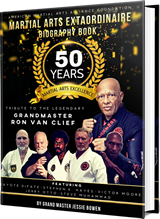
Master Peter Urban, a disciple of Gogen Yamaguchi brought the style of Goju-Ryu to the United States in 1959. In 1964 Master Peter Urban founded the U.S.A. Goju Association. Master's Frank Ruiz, Harry Rosentein and Ron Taganashi, all students of Grandmaster Peter Urban, founded the Nisie Goju Ryu system in 1969. Master Ron Van Clief founded the Chinese Goju system on January 25, 1971. Master Van Clief is a disciple of Grandmaster Peter Urban, Frank Ruiz, Moses Powell and Leung Ting. After many years of study in Karate, Aiki-Jutsu, Ju-Jutsu, Zen-Jutsu and Kung-Fu, Master Ron Van Clief desired to bring the Goju system closer to its Chinese roots, due to the distinct ideologies of the Japanese, Chinese and American cultures. He combined the animal forms and soft aspects of his Chinese arts training, with the hard and soft characteristics of Japanese Martial arts.
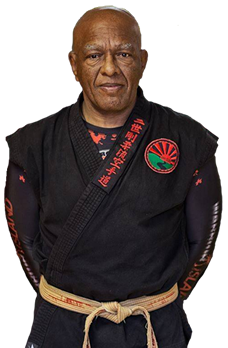
Shidoshi (Grandmaster) Ron Van Clief's Chinese Goju system is a total martial arts concept combining the Eastern and Western ideologies with American ingenuity. The system is influenced by the circular hand movements of Chinese arts along with the grace and power of Japanese and Okinawan Goju.
Chinese Goju techniques are distinctive with great effectiveness. Many of the blocks and strikes are performed with exposed palms, fast and strong in application with a powerful snap. The movements are executed strategically in and out and circular side patterns, in contrast to traditional karate of hard style, were the movements are straight forward and back.
According to Ron Van Clief, the basics of Chinese Goju are a reconstruction of philosophy in the martial arts ideology.
The essence of Chinese Goju is the development of the individual. Through proper training in the art of Chinese Goju the student acquires the mental, physical and spiritual harmony necessary to acclimate to the ever changing environment.
Through the introspective perception developed within the martial arts criteria Chinese Goju teaches its students that change is constant.
According to Ron Van Clief, the basics of Chinese Goju are a reconstruction of philosophy in the martial arts ideology.
Chinese Goju advanced students understand the full range of their human potential; with the implementation of Chinese Goju philosophy, the student understands Goju ideology, hard and soft in concept and technique.
Chinese Goju teaches fluidity and flexibility of the mind and body for human development.